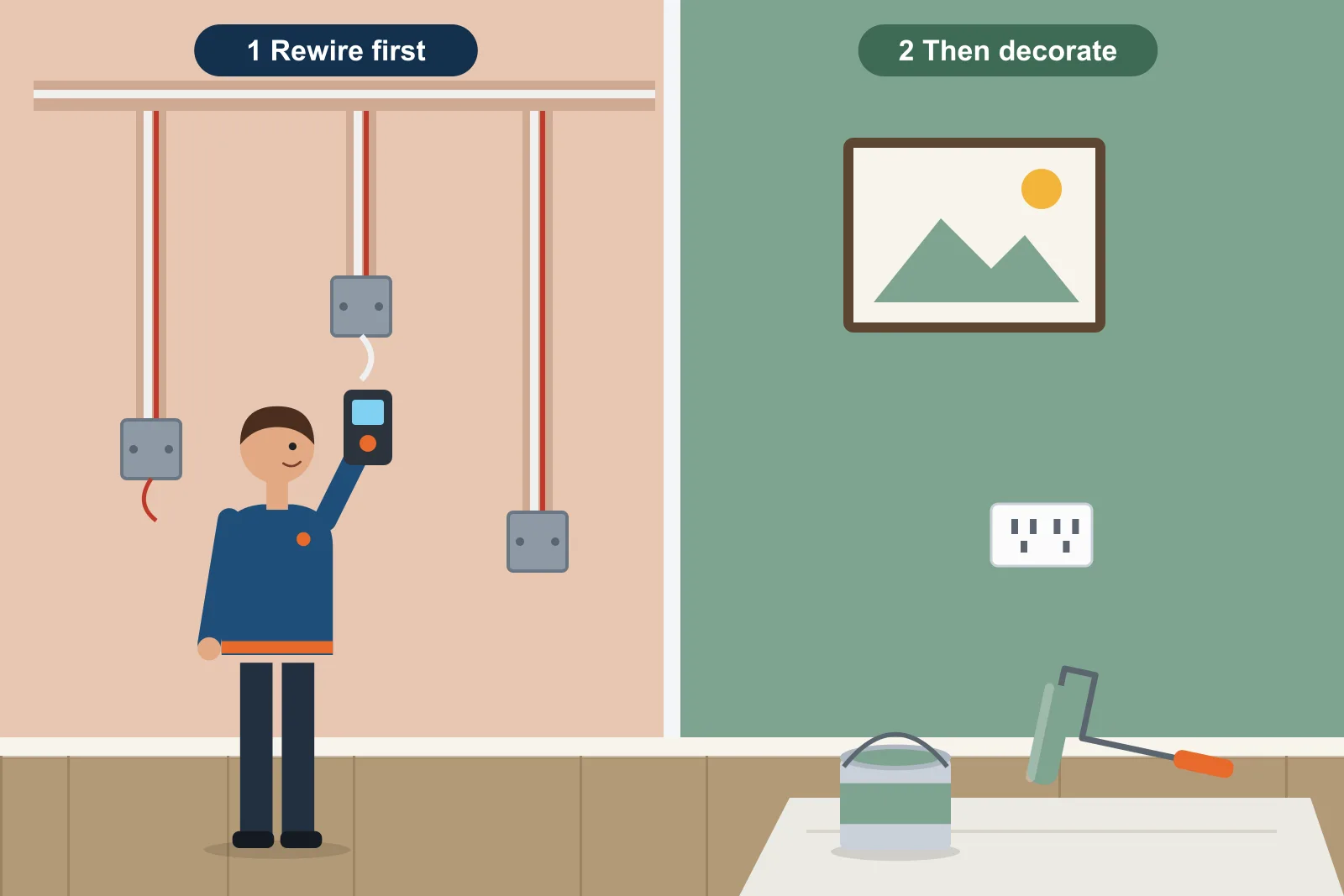
The short answer
Yes. If a house needs rewiring, or is likely to in the next few years, the electrical work should come first and the painting and decorating last. A rewire is one of the messiest jobs a home can go through. Old cables are pulled out, walls are cut open to bury new runs, floorboards are lifted and ceilings are opened up for new light positions. Even the tidiest electrician leaves damaged plaster and a fine film of dust behind.
Decorating first and rewiring second means paying for the same rooms twice. Patching a chased wall so that it disappears under existing paint is very hard, and most decorators will tell you it's quicker to repaint the whole wall than to try to blend in a repair. Wallpaper is worse: a chase through a patterned paper usually means stripping and rehanging the entire wall.
What a rewire does to your walls and ceilings
It helps to picture what actually happens during a rewire, because it explains why the order of work matters so much.
First fix: the disruptive part
During the first fix the old cables come out and new ones go in. In most British homes that means cutting narrow channels, known as chases, into the plaster so cables can drop vertically to sockets and switches. Metal back boxes are set into the wall at each point. Upstairs, floorboards are lifted so cables can run between the joists, and every new light position means a hole in the ceiling below.
In a solid-walled Victorian terrace, chasing is noisy, dusty work through brick and old lime plaster. In a newer home with plasterboard walls, cables can often be fed down inside the stud wall with fewer chases, but there will still be holes to fill.
Making good
Once the cables are in, the walls need repairing. This is called making good, and it's worth checking who is responsible for it before any work starts. Some electrical quotes include filling the chases; others leave it for a plasterer. In older houses the vibration of chasing can loosen larger areas of fragile plaster, and a section of wall may need replastering rather than simply filling.
Second fix
With the walls repaired, the electrician returns to fit faceplates, light fittings and the consumer unit, then tests and certifies the installation. This is the stage where the timing of your decorator needs a little thought, which we cover further down.
Signs your wiring should be checked before you decorate
You don't need to rewire a house just because it's old, and plenty of installations from the 1980s and 1990s are perfectly sound. But some features suggest the wiring is near the end of its life, and they're worth looking for before you start choosing colours:
- An old fuse box with rewirable fuses rather than a consumer unit with circuit breakers
- Rubber-, lead- or fabric-covered cables visible in the loft, under the stairs or behind a light fitting
- Round-pin sockets, or sockets set low down in the skirting board
- Light switches mounted on wooden blocks, or old brown Bakelite fittings
- Scorch marks, warm sockets, a burning smell or lights that flicker for no obvious reason
- No RCD protection, or circuits that trip regularly
Full rewire, partial rewire or a few new sockets
The result of the inspection will usually fall into one of a few categories, and each has a different knock-on effect on your decorating plans. If the report says the installation needs replacing, arrange a full or partial rewire with a qualified electrician before you commit to a decorating date. A rewire is also the cheapest moment to add the extra sockets, outside lights and USB points you've always wanted, because the walls are already open.
As a rough guide, a full rewire of a three-bedroom semi often costs £5,000–£9,000, while decorating the inside of the same house can run to £3,000–£6,500. Getting the order wrong can mean paying a large part of that second figure twice.
| Electrical work | Typical disruption | What it means for decorating |
|---|---|---|
| Full rewire | Chases in most rooms, boards lifted, ceilings opened | Decorate the whole house after the rewire and making good |
| Partial rewire (e.g. kitchen circuits or one floor) | Limited to the rooms on the affected circuits | Leave those rooms until last; others can go ahead |
| A few extra sockets or a new light | One or two short chases in the room | Do it before painting that room, or allow for repainting a wall |
| Consumer unit replacement only | Little or none outside the cupboard | No real effect on decorating |
How different levels of electrical work affect your decorating
The right order of work
For a house that needs both electrical work and redecoration, a sensible sequence looks like this:
- Electrical inspection, so you know the full scope of the work
- First fix: old wiring out, new cables and back boxes in
- Any other work that opens walls or floors, such as heating or plumbing changes
- Making good: chases filled or walls replastered
- Drying time for any new plaster
- Mist coat on new plaster, then the finishing coats
- Second fix, testing and certification, if not already done
Rather leave it to a professional?
Faceplates: before or after painting?
Decorators and electricians each have their preferences here. Many decorators would rather paint with the faceplates eased away from the wall, so they can cut in neatly behind them and avoid a crisp line of paint around every socket. The catch is that a back box with cables in it must never be left open in a home that's being lived in once the circuits are live.
The usual compromise is for the electrician to finish and test the installation first. While the walls are painted, the faceplates are loosened slightly with the circuit switched off, then tightened again afterwards. If you've chosen metal or coloured faceplates, it's usually better to fit them after the final coat so they don't get marked or splashed. Whatever approach you choose, agree it with both trades before work starts.
How long to wait before the decorator starts
The gap between the rewire and the decorator depends almost entirely on how the walls were repaired. Chases filled with a quick-setting filler can usually be sanded and painted within a day or two. Chases filled with bonding coat and skimmed need longer, and a fully replastered wall has to dry right through before it's painted. That can take anything from a week or two for a thin skim in warm weather to four weeks or more for thicker plaster in winter.
Painting too soon traps moisture, which leads to blistering and peeling. Where new plaster is involved, the first coat should be a thinned mist coat rather than full-strength emulsion, so the paint bonds properly to the thirsty surface.
A real-world example
Take a three-bedroom 1930s semi bought with its original fuse box and a mixture of old and newer cabling. The new owners want every room repainted before they move in. An EICR finds several dangerous and potentially dangerous defects and recommends a rewire.
Their best plan is to push the decorating back. The electrician rewires the house over a week and a half, a plasterer skims the worst-affected walls the following week, and the decorator starts three weeks later, once the plaster has dried to an even pale pink. The owners lose about a month from their timetable but pay for the decorating once. Had they painted first, almost every room would have needed at least one wall redone.
Can you decorate now and rewire later?
Sometimes there's no choice. A rental property may need to be let quickly, or the budget for a rewire simply isn't there yet. If the wiring has been checked and is safe for now, decorating in the meantime is reasonable, but keep it modest. Choose a standard colour you can easily buy again for touch-ups, note the exact shade and finish, and hold back on expensive wallpaper or specialist finishes in rooms that will need chasing later.
When the time comes, tell the electrician the rooms are already decorated. Many will route cables through floor voids and the loft wherever possible, or use neat surface trunking in less visible spots, to keep the damage down. It won't be invisible, but it can mean repainting one wall rather than a whole room.
Final thoughts
Painting and decorating is the finishing touch on any renovation, and that's exactly where it belongs in the timetable. If your wiring is old, untested or showing warning signs, have it inspected first, then let the electrical work, the plastering and the drying time run their course. The few weeks you wait will be repaid by a finish that stays fresh for years, rather than one that's patched within months.